How do reception and return centres work?
Asylum seekers and persons with expulsion decisions shall live at reception and return centres. What is a reception and return centre and how do the centres work in practice? We clarify that in this part of The Swedish Migration Agency answers.
Published 27 March 2026
Asylum seekers' housing has varied over the years – from refugee camps to many also living in accommodation they arranged themselves, often with friends or relatives. Now the system is about to change. The Government wants asylum seekers and persons who receive a refusal to live in the Swedish Migration Agency's asylum accommodation. The new housing facilities are called reception and return centres.
The idea with the centres is that those who live there shall have proximity to service and information. But it is also about the asylum process being fast and efficient – from application to a decision on a residence permit or a refusal and return.
All the Swedish Migration Agency's centres are called reception and return centres, but some have more focus on reception (places for persons who have applied for asylum and are waiting for a decision). Other centres have more places for persons who are to return.
Who lives at the centre and for how long
Who shall live at the centres?
All asylum seekers receive a place at a reception and return centre when they submit their application. In order to be entitled to financial aid from the Swedish Migration Agency, one must move to the place one is assigned.
Persons who receive a refusal on their asylum application receive a place at a centre with return places when their expulsion decision has gained legal force (when the decision has begun to apply). They shall then live there until they leave the country.
How long shall one live there?
Asylum seekers shall live at the centres while they wait for a decision in their case. Since all applications are examined individually, it is not possible to say how much time is involved, but the idea is that it shall facilitate the asylum process that all parts are gathered in one place.
Persons who receive a decision that means they shall return shall live at the centres until they leave the country. As a rule, one shall do so at the latest four weeks after the expulsion decision begins to apply. How long it takes before one returns often depends on how much the person himself cooperates, for example by obtaining the documents and papers required to travel.
With the EU's Migration and Asylum Pact, time limits are also introduced which state how long different parts of the asylum process shall take.
Available in eleven municipalities
The Swedish Migration Agency has so far started from locations where the authority previously had activities and housing when we established reception and return centres. At present, there are centres in eleven municipalities: Boden, Härnösand, Västerås, Sigtuna, Stockholm, Flen, Vänersborg, Mölndal, Halmstad, Malmö och Burlöv.
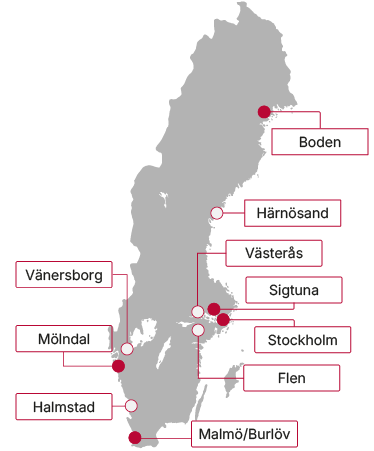
The image shows a map of Sweden where reception and return centres are marked. Red circle shows center with asylum examination. White circle shows center without asylum examination.
How many live at the centres?
The number of residents at the centres changes all the time because new persons move in after having applied for asylum, while others move out after having received a residence permit or travelled out from Sweden after a refusal. Persons can also move out for other reasons, for example because they have absconded, been taken into detention or moved to another type of housing due to illness.
In February 2026, the Swedish Migration Agency had a total of approximately 5 500 places in reception and return centres. At that time, approximately 1 870 persons lived at the centres and of them, about 400 persons were under 18 years.
Safety, security and activities
Included in the Swedish Migration Agency's mandate is to ensure that there is a safe and secure environment at the centres, not least for children and vulnerable groups. To achieve that, there is a possibility to divide the housing into different sections, so that for example women and families with children live by themselves. The presence of the Swedish Migration Agency's staff is also important for safety and the Swedish Migration Agency is now increasing the staff presence. When necessary, there are also security guards who shall contribute to a safe environment.
At the centres, activities are also offered which are arranged in collaboration with, for example, voluntary organisations such as the Red Cross and Save the Children. The Swedish Migration Agency can also arrange activities under its own management.
Living as a child at the centres
The Swedish Migration Agency has a responsibility to ensure that there is a good and safe environment for children at the centres, among other things by ensuring that there are rooms for play, activity and studies. The size of rooms shall vary so that it fits both smaller families and families with several children. The Swedish Migration Agency also attaches importance to the outdoor environment.
Children who live in reception and return centres have the right to attend preschool and school on the same terms as other children in Sweden.
Changes with the Migration and Asylum Pact
That asylum seekers shall live at reception and return centres is in line with the EU's Migration and Asylum Pact which is introduced on 12 June. The pact's legislation is mandatory for all EU countries and means, among other things, that the asylum process shall look the same in the entire EU.
With the Migration and Asylum Pact, a screening procedure is introduced. This means that all third country nationals (persons from countries outside the EU) who cross the EU's external border without the documents and papers required shall be checked. Even persons who are encountered in an EU country without a valid permit can be covered by the screening if the person entered without necessary documents.
More changes regarding asylum seekers' housing
Further legislation regarding asylum seekers' housing is underway nationally ahead, with the Reception Act which is proposed to enter into force in October 2026. The proposal means, among other things, that asylum seekers shall be obliged to stay within a limited geographical area and participate in presence checks at the Swedish Migration Agency's housing.
Read more about the EU's Migration and Asylum Pact and the new protection process
Read more about the Reception Act (only in Swedish) External link.
Who comes to Sweden – and why?
Around 190,000 people applied for a residence permit in Sweden last year, and 132,000 people were granted permission to be here. These included refugees, employees, students and close relatives of people who already live here, from all over the world. In this article, we will answer questions about who comes to Sweden, why, and how migration to Sweden developed between 2013 and 2022.*
Voluntary repatriation and repatriation grants – what are they?
Lately, the issue of repatriation and repatriation grants has occupied a significant place in the migration debate – among politicians, public organizations, and the general public alike. What does voluntary repatriation actually mean, and how large of a repatriation grant can one receive? We clarify this in this section of "The Swedish Migration Agency answers".
.png)
Unaccompanied minors – how have asylum applications evolved over the past ten years?
From tens of thousands to a few hundred per year – the number of asylum-seeking unaccompanied minors and young people who come to Sweden has declined sharply over the past decade.