How do you become a Swedish citizen?
With approximately 50,000 applications for Swedish citizenship each year, this is one of the Swedish Migration Agency’s most significant and most debated case types. Here we explain the process of becoming a Swedish citizen following the legislative changes in June 2026. The article also includes simple statistics covering the past three years.
Published 17 July 2026
There are different ways to become a Swedish citizen: by application, by notification, or automatically at birth or through adoption. A child becomes a Swedish citizen at birth if one of the parents is a Swedish citizen, but it may also apply to a child who is adopted by a Swedish parent.
A notification of citizenship is a simplified route to becoming a Swedish citizen compared with an application. Not everyone is eligible to acquire Swedish citizenship by notification; it applies to certain groups such as Nordic citizens, and children or young adults who have been stateless since birth. We will return later in the text to what applies to Nordic citizens.
Notification for stateless persons aged 18 to 21
Notification for stateless children
This article mainly focuses on individuals who wish to become Swedish citizens through application – as this is the most common route and accounts for the largest number of citizenship cases each year.
Requirements for becoming a Swedish citizen through application
The requirements for acquiring Swedish citizenship through application are set out in the Swedish Citizenship Act. On 6 June 2026, the Act was amended and the requirements for becoming a Swedish citizen were tightened. The revised rules applied immediately to everyone – including applicants who had submitted their application before 6 June and were still awaiting a decision.
Since 12 July 2026, an exemption from the requirement to hold a permanent residence permit applies to certain groups. Individuals who fall within these groups may therefore apply for Swedish citizenship even if they do not hold a permanent residence permit, provided they have well-founded prospects of being granted a long-term residence permit.
Read about the exemption from the requirement for a permanent residence permit
Different rules apply to Nordic citizens
For citizens of Denmark, Finland, Iceland, or Norway, separate provisions apply, and there are several different ways to become a Swedish citizen – either through application or notification, depending on how long the person has lived in Sweden.
How identity is verified
The requirement to prove your identity consists of two parts. The first is that you must hold an identity document, such as a national passport or identity card. The second is that you must attend the Swedish Migration Agency in person, known as personal appearance. The purpose of personal appearance is to enable the Swedish Migration Agency to verify that the person who submitted the application and appears in the photograph on the identity document is the same person who is physically present at the agency.
How long must you have lived in Sweden?
The general rule is that you must have lived in Sweden continuously for at least eight years in order to be granted Swedish citizenship.
Requirement to have lived an orderly and respectable life
Having lived an orderly and respectable life means that you must not have unpaid debts or have committed criminal offences in Sweden. To assess this, the Swedish Migration Agency obtains information from the Swedish Enforcement Authority, the Swedish Police Authority and the Swedish Security Service. On 6 June 2026, the good conduct requirement was strengthened to include conduct outside Sweden. The Swedish Migration Agency assesses this on the basis of the information provided by the applicant and any other information available in the case, such as information submitted by third parties.
Debts and criminal offences may affect when you can be granted citizenship
If you have unpaid debts or have committed criminal offences, you may still be granted Swedish citizenship. However, a certain period must have passed after the debt has been settled and any sentence has been served. This is known as a qualifying period, and its length depends on the nature of the offence.
You must be able to support yourself
To be granted Swedish citizenship, you must be able to support yourself through your own income from employment or self-employment. The income must be long-term rather than temporary and amount to at least three income base amounts (inkomstbasbelopp) per year. This corresponds to a monthly income of just over SEK 20,000 before tax.
There is no requirement regarding the extent of your employment, for example whether you work part-time or are employed on an hourly basis. The applicant must meet the maintenance requirement through their own income. It is therefore not acceptable to combine your income with that of your partner.
Parental benefit and sickness benefit count as income
If you temporarily receive work-related benefits while employed, these may be taken into account when the Swedish Migration Agency assesses whether you meet the maintenance requirement, as such benefits are treated in the same way as salary. Examples include parental benefit during parental leave and sickness benefit during sick leave.
Income that does not count
To meet the maintenance requirement, you cannot count income from a new start job (nystartsjobb) or from employment subsidised through a special employment support programme provided by the Arbetsförmedlingen. You also cannot count unemployment benefit, or have received social assistance for a period exceeding six months during the previous three years.
Applicants who are self-employed cannot count income received through start-up support for business activities (commonly referred to as the starta eget grant) provided by the Swedish Public Employment Service (Arbetsförmedlingen).
Exemptions from the maintenance requirement
Some people are exempt from the maintenance requirement. This includes, for example, those who are entitled to certain types of pension and those studying full-time with satisfactory results at a university, university college or higher vocational education institution. People who, because of a disability or similar circumstances, cannot reasonably be expected to meet the maintenance requirement may also be exempt.
Read more about the maintenance requirement and who is exempt
Requirement to have knowledge of Swedish and Swedish society
Applicants aged 16 to 66 must meet a knowledge requirement in order to become Swedish citizens. This means demonstrating knowledge of both the Swedish language and Swedish society.
You can show that you meet this requirement, for example, by providing: school-leaving certificates from Swedish compulsory or upper secondary school;certificates from municipal adult education (Komvux) or a folk high school; or a passing grade in Swedish for Immigrants (SFI).
Applicants who cannot provide documentary evidence of their knowledge may instead take a citizenship test.
The Swedish Migration Agency may grant an exemption from the knowledge requirement if the applicant has a disability or other circumstances that make it unreasonable or impossible to meet the requirement.

How the citizenship test works
The citizenship test is available to applicants who cannot demonstrate their knowledge through approved educational qualifications. The Swedish society test will be available from August 2026, while the Swedish language test is expected to be introduced no earlier than autumn 2027.
Applicants may also demonstrate their Swedish language skills by achieving a passing result in the Tisus test. Tisus is intended for people with a foreign upper secondary education who do not have Swedish school qualifications and wish to study at a Swedish university or university college. During a transitional period, other recognised Swedish language tests, such as Swedex, may also be accepted. This means that applicants who would otherwise need to take the Swedish language citizenship test may instead demonstrate their language skills through an approved language test.
Once the citizenship test becomes available, the Swedish Migration Agency will invite applicants who do not meet the knowledge requirement by other means to take the test.
Children must have their own application
Previously, a minor child could become a Swedish citizen together with a parent by being included as a co-applicant in the parent's citizenship application. This is no longer possible. Instead, the child's legal guardian must submit a separate application for Swedish citizenship on the child's behalf. If the child is 12 years of age or older, they must consent to the application. As children are not subject to the maintenance requirement, their application is not affected by whether their parents meet that requirement.
How many people apply for Swedish citizenship
So far in 2026, up to approximately the middle of June, the Swedish Migration Agency has received just over 28,000 applications for Swedish citizenship. In comparison, the Agency received 41 000 applications in 2025; 50 000 in 2024 and 58 400 in 2023.
Applications for Swedish citizenship received, 2023–2025
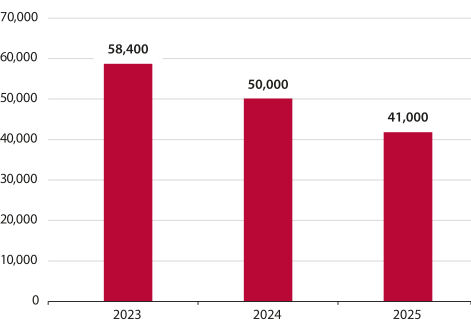
The chart shows the number of applications for Swedish citizenship received during 2023, 2024 and 2025.
The Swedish Migration Agency granted 38,800 Swedish citizenships in 2025, 65,600 in 2024, and 68,200 in 2023. The reason why the number of granted citizenships was significantly lower in 2025 than in previous years is mainly that the Agency introduced measures to strengthen security in the decision-making process. These measures involved additional processing steps, which resulted in fewer decisions being made.
Applications for Swedish citizenship approved, 2023–2025
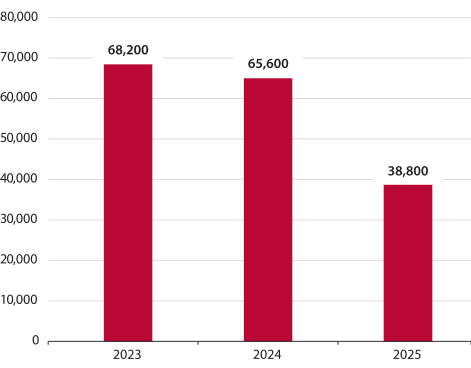
The chart shows the number of approved applications for Swedish citizenship in 2023, 2024 and 2025.
The figures are rounded to the nearest hundred and are taken from the Swedish Migration Agency’s Annual Report for 2025, as well as statistics published on our website.
Annual Report 2025, Swedish Migration Agency (only in Swedish) pdf, 4.7 MB, opens in new window.
Official statistics of the Swedish Migration Agency (only in Swedish)
Who becomes a Swedish citizen?
Among those who were granted Swedish citizenship in 2025, the five most common previous citizenships were Syrian, Afghan, Eritrean, Indian and Polish. The largest groups of new Swedish citizens in 2023 and 2024 also came from Syria, followed by Afghanistan and Eritrea.
The five most common previous citizenships in 2025
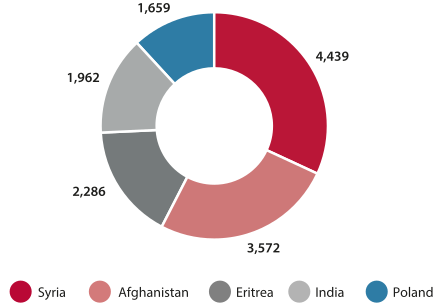
The chart shows the five most common previous citizenships among people who were granted Swedish citizenship in 2025.

What is the new EU migration and asylum pact about?
The EU has adopted a new regulatory framework reforming the Member States' asylum and migration systems. In this section of the Swedish Migration Agency Answers, you can read about the new rules and how they will affect asylum seekers and migration management in the EU.

What is the Swedish Migration Agency doing to combat abuse and crime?
People tend to think of organised crime, welfare abuse and security threats as matters for the police or the Swedish Security Service. But the Swedish Migration Agency also plays an important role in preventing and combating criminality and the abuse of Sweden’s welfare and regulatory systems – as this article will highlight.
Work permits – what are the latest developments?
Who comes to Sweden to work, where do they come from and what kinds of jobs do they do? How quickly do they receive a decision on their applications, and what reforms have been introduced recently? This article summarises developments in work permits.