Work permits – what are the latest developments?
Who comes to Sweden to work, where do they come from and what kinds of jobs do they do? How quickly do they receive a decision on their applications, and what reforms have been introduced recently? This article summarises developments in work permits.
Published 19 October 2026
Every year, thousands of people apply for residence permits to work in Sweden. Several reforms have been introduced in recent years, including a higher salary requirement and stronger measures by the Swedish Migration Agency to reduce fraud and the exploitation of workers. At the same time, the Agency has been working on behalf of the Government to make it easier for highly qualified workers to come to Sweden.
The statistics in this article reflect these changes and developments in the area of work permits.
Applications for work permits
How many people apply?
Last year, just over 16,000 people applied for residence permits in Sweden because they had obtained employment in the country, while just under 20,000 applied for an extension of their permit. The number of applicants has fallen since 2023, when the corresponding figures were approximately 24,000 first-time applications and approximately 23,000 applications for extensions.
These decreases may be due to the tightening of legislation in this area. Among other changes, the salary requirement has been raised gradually, and the option for asylum seekers to apply for a work permit instead has been abolished. This was known as “changing tracks”.
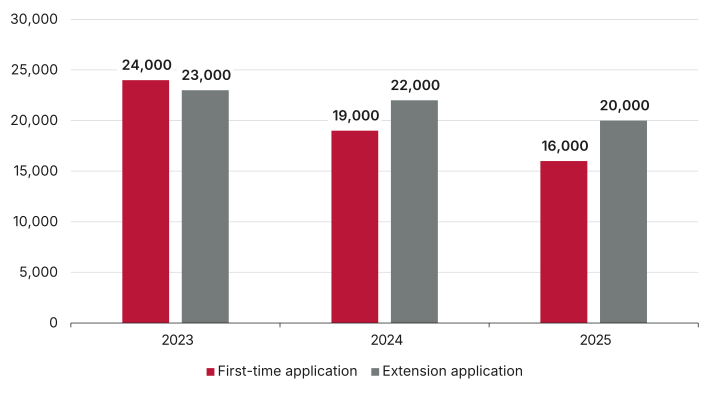
The number of applications decreased between 2023 and 2025. The decrease was greater for first-time applications than for extension applications. All figures in the chart are rounded to the nearest thousand.
How many people are granted residence permits?
In 2025, approximately 11,000 employees were granted residence permits in Sweden for the first time. Just under 20,000 employees had their permits extended.
How many fewer people are applying for work permits?
The chart above shows a decline in the number of work permit applications up to 2025. The decrease has been greatest in sectors requiring more extensive investigation, such as the restaurant, cleaning and construction sectors, where salary levels may make it difficult to meet the increased maintenance and salary requirements for work permits.
For applications relating to highly qualified occupations, where salaries are generally higher, the decrease in first-time applications between 2024 and 2025 was only six per cent.
People who come to Sweden to work
Distribution between men and women
More men than women apply for and are granted residence permits to work in Sweden. Of the 11,000 employees who were granted work permits following a first-time application in 2025, just over 8,000 were men and just under 3,000 were women.
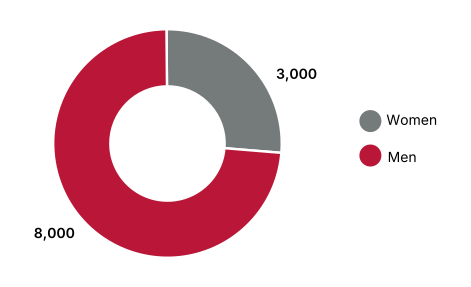
Men accounted for a clear majority of employees in 2025. Figures are rounded to the nearest thousand.
The most common citizenship
People come from all over the world to work in Sweden. Last year, employees from around 100 different countries were granted residence permits in Sweden.
The table shows the five most common nationalities among people who have been granted a work permit for the first time.
Country | Number |
|---|---|
1. India | 2,633 |
2. Thailand | 1,974 |
3. Türkiye | 764 |
4. China | 679 |
5. United Kingdom | 457 |
Employees from India, which tops the list, mainly work in occupations requiring higher education qualifications or equivalent qualifications. Highly qualified workers also predominate among those from China and the United Kingdom. Employees from Thailand mainly work in agriculture, horticulture and forestry, while those from Türkiye represent a mix of skills: approximately half work in highly qualified occupations, and the other half in construction, manufacturing and occupations requiring less formal education.
See more statistics on work permits (only in Swedish)
What professions do they work in?
The Swedish Migration Agency’s statistics show that employees come to Sweden to work in a wide range of occupations. Around half apply for and are granted work permits on the basis of employment in a highly qualified occupation, such as IT specialists, technicians and engineers. For some jobs, for example in agriculture and berry picking, it is common to apply for a permit for seasonal work.
Seasonal workers granted permits in 2026 (only in Swedish)
The largest occupational groups for work permits in 2025
The table shows the ten most common occupational categories among people who have been granted a work permit for the first time.
Country | Number |
|---|---|
1. IT architects, systems developers, test managers and related occupations | 2,182 |
2. Engineers and technicians | 1,147 |
3. Engineering professionals | 1,068 |
4. Agricultural and horticultural crop growers | 956 |
5. Berry pickers and planters | 728 |
6. Forestry workers | 646 |
7. IT operations, support and network technicians and related occupations | 250 |
8. Fast-food staff, kitchen assistants and restaurant assistants | 218 |
9. Cooks and cold-buffet chefs | 191 |
10. Organisational development specialists, HR specialists and related occupations | 173 |
This is how the figures break down by county
Where in Sweden do they work?
The Swedish Migration Agency has information about the place of population registration of people holding residence permits on the basis of employment. This information does not show where a person works, but it gives an indication of which counties employees come to. As the map shows, the metropolitan counties top the list, but it also includes counties where one or two employers attract workers from abroad, such as Norrbotten.
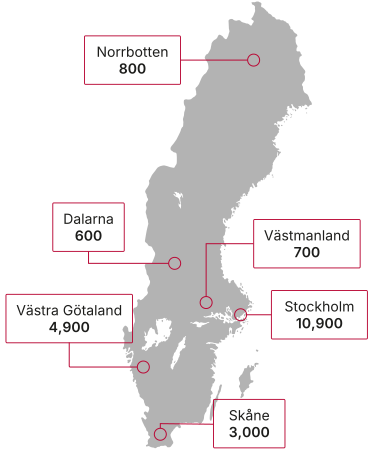
Stockholm County had the largest number of people holding temporary residence permits for work who were registered in the population register, followed by Västra Götaland and Skåne. Norrbotten, Västmanland and Dalarna were also among the six counties with the highest numbers. Figures are rounded to the nearest hundred.
Which employers recruit workers from abroad?
The Swedish Migration Agency does not have comprehensive statistics on which companies employ people from countries outside the EU*. However, the available data shows that in 2025, many people with work permits were employed by Swedish and international companies operating in the following sectors:
- IT consultancy, such as Tata Consultancy and Capgemini.
- Electrical power and energy infrastructure, such as Hitachi Energy and Elnos Nordic.
- Vehicle manufacturing, electrification and automation, such as Volvo and Scania.
- Companies involved in building the new steel plant in Boden, including Stegra.
Family members of employees
The Swedish Migration Agency’s statistics show the total number of family members who apply for and are granted permits as family members of employees. Last year, approximately 10,000 family members of employees applied for residence permits in Sweden.
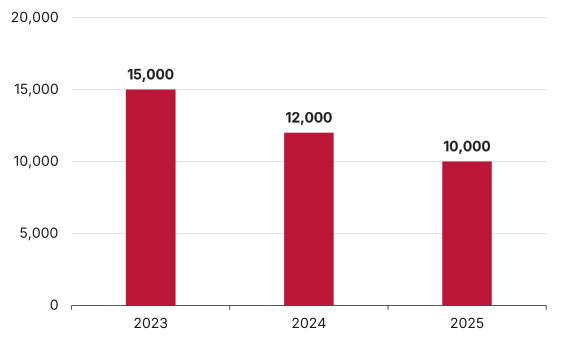
The number of applications from family members of employees decreased between 2023 and 2025. All figures are rounded to the nearest thousand.
Statistics Sweden has conducted a study of labour immigrants and their accompanying families. According to the study, 2,600 partners and 2,500 children of employees immigrated to Sweden in 2023.
Among the employees, approximately one third of the men and one quarter of the women brought their partner to Sweden, while approximately one fifth brought children with them.
The higher the level of qualification, the more common it is to bring family members. Bringing family members was particularly common among men in highly qualified occupations.
Processing times
Since 2024, the Swedish Migration Agency has focused on improving its service to employers and providing clear information to employees. The aim is for as many applications as possible to be complete from the outset, making it easier for the Agency to reach decisions quickly.
Processing times for highly qualified workers
For highly qualified workers, the Swedish Migration Agency has a service pledge to reach a decision within 30 days if the application is complete. This applies to both first-time and renewal applications in this category, including those for family members.
Since the new way of working was introduced, processing times for these cases have remained stable and consistently short. In 2026, decisions were reached within 30 days in more than 80 per cent of these cases.
A new approach to work permits has delivered results (only in Swedish)
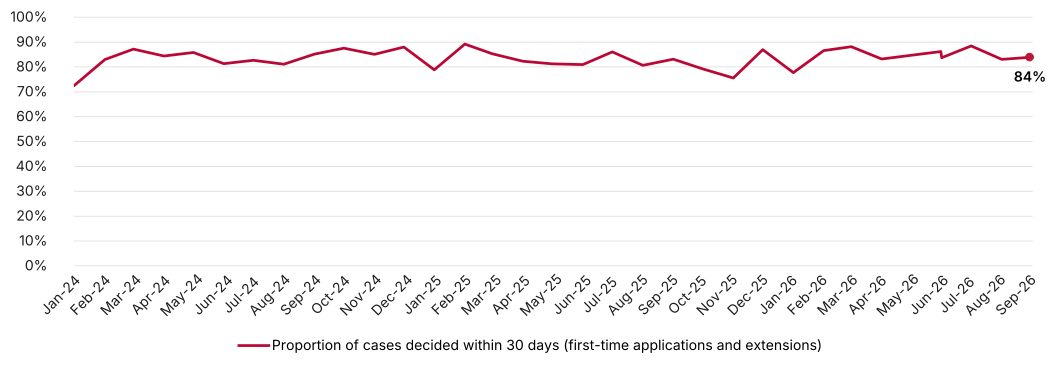
The proportion of cases decided within 30 days has remained stable over time. In 2026, more than 80 per cent of cases were decided within 30 days.
The Swedish Migration Agency has also established a dedicated function to receive enquiries and provide tailored information to employers recruiting highly qualified workers, including universities and other higher education institutions.
If you are employing highly qualified workers
Shorter waiting times for all occupational categories
Under Swedish legislation, a decision on a work permit case must be reached within four months of a complete application being submitted, unless there are special grounds. Processing times for all cases include both applications that require additional information or documents and cases requiring particularly extensive investigation.
These statistics therefore cover not only employees, but also family members, researchers, self-employed people and other groups included in the category “residence permits on the basis of work”. The proportion of cases in the category decided within four months has also increased significantly in recent years.
This can be explained both by the Swedish Migration Agency’s efforts to improve its service and shorten processing times, and by the decline in the proportion of work permit applications in sectors requiring more extensive investigation.
So far this year, decisions have been reached within 120 days in three out of four work permit cases. This proportion has increased gradually since 2023, when one in two cases was decided within 120 days.
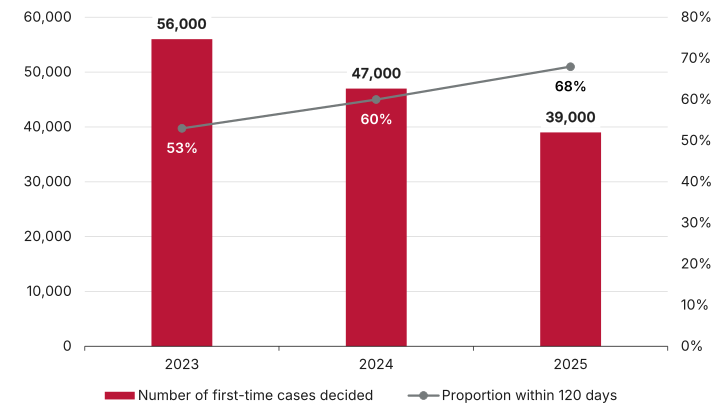
The number of cases decided decreased between 2023 and 2025, while the proportion of cases decided within 120 days increased. Percentage values are rounded to the nearest whole percentage point.
The number of cases awaiting a decision at the end of the year is generally referred to as the backlog and can provide another measure of how efficiently we process applications. The backlog of applications for “residence permits on the basis of work” decreased during the period 2023–2025.
For first-time applications, the number of pending cases fell from just over 20,000 at the end of 2023 to approximately 10,000 at the end of 2025.
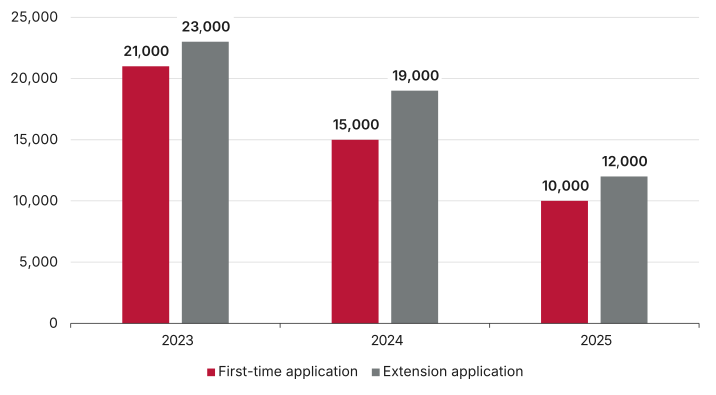
The number of pending cases decreased between 2023 and 2025 for both first-time and extension applications. The decrease was greater for first-time applications.
Important changes in 2026
Several reforms relating to work permits in Sweden have been introduced in 2026.

Voluntary repatriation and repatriation grants – what are they?
Lately, the issue of repatriation and repatriation grants has occupied a significant place in the migration debate – among politicians, public organizations, and the general public alike. What does voluntary repatriation actually mean, and how large of a repatriation grant can one receive? We clarify this in this section of "The Swedish Migration Agency answers".

How have migration regulations changed?
Several reforms and legislative changes have affected the migration area. Has it become more difficult to obtain protection in Sweden? Is it easier to receive financial support to return to one’s country of origin? Has expulsion due to criminal offences become more common? In this article, we clarify what has changed and what is to come.
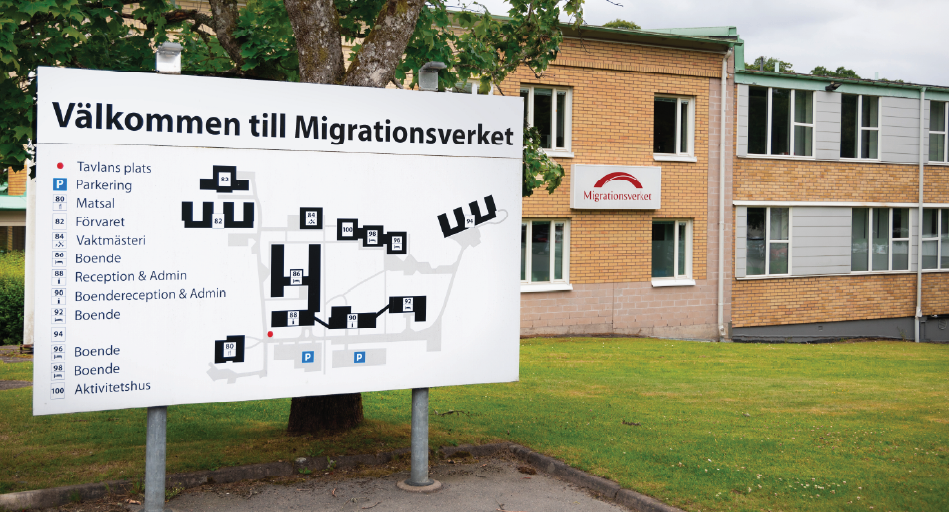
How do reception and return centres work?
Asylum seekers and persons with expulsion decisions shall live at reception and return centres. What is a reception and return centre and how do the centres work in practice? We clarify that in this part of The Swedish Migration Agency answers.